

For most of my adult life, I never thought of myself as someone with “gut issues.”
I thought about stress. I thought about sleep. I thought about focus, productivity, and more recently, the mental load of running businesses across time zones from rural Cambodia. What I didn’t think about was how much of that was showing up in my gut — in the cravings that hit hardest when I was most anxious, in the way comfort food felt like the only available off-switch, in the cycle of eating something I knew wasn’t serving me and feeling worse for it in ways that had nothing to do with willpower.
It wasn’t until I started going deep on ECS research — the endocannabinoid system — that I started connecting the dots. Because it turns out the gut isn’t just where your food goes. It’s where a significant portion of your body’s regulatory intelligence lives. And the ECS is right in the middle of it.
This is what I wish someone had explained to me earlier.
Your Gut Is Not Just a Digestive Organ
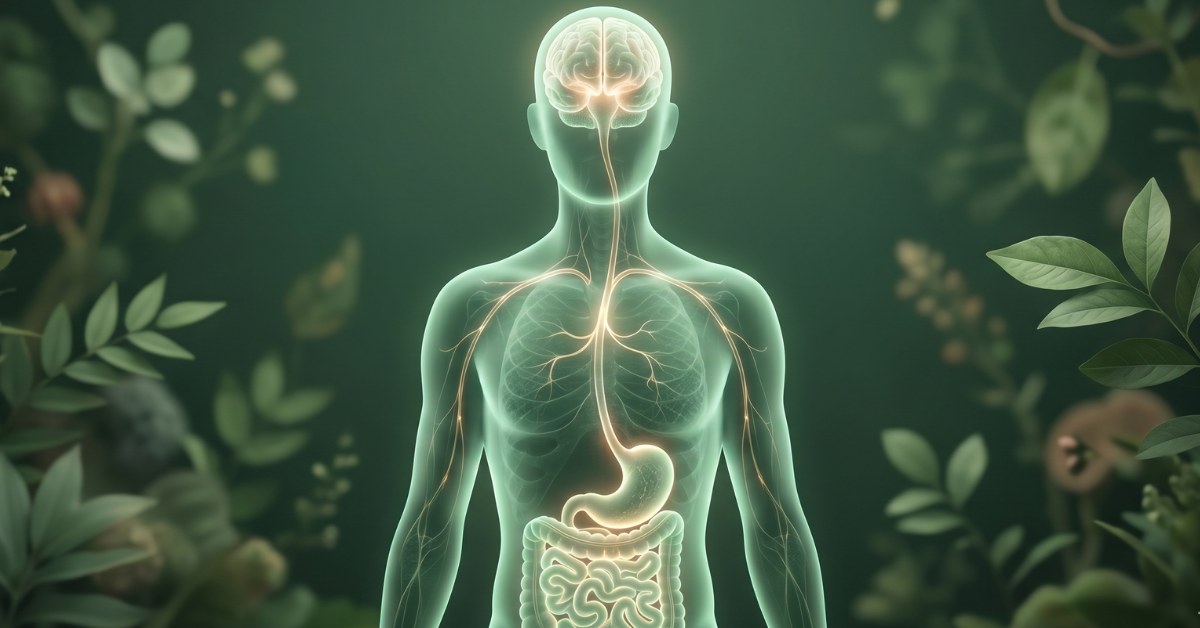
You’ve probably heard the gut called the “second brain.” It’s a useful shorthand, but it undersells what’s actually going on.
Your gastrointestinal tract contains more than 500 million neurons — more than your spinal cord. It produces about 95% of your body’s serotonin. It hosts trillions of microorganisms that actively communicate with your brain, influence your mood, and — research is now confirming — shape your cravings, your stress response, and your sleep quality.
>> If gut discomfort, inflammation, or the stress-craving cycle sounds familiar — the Extra Strong formula is where I’d start. CBD and CBG in a 2:1 ratio, with only trace amounts of naturally occurring THC, built for daily use.
👉 Explore the Extra Strong Tincture
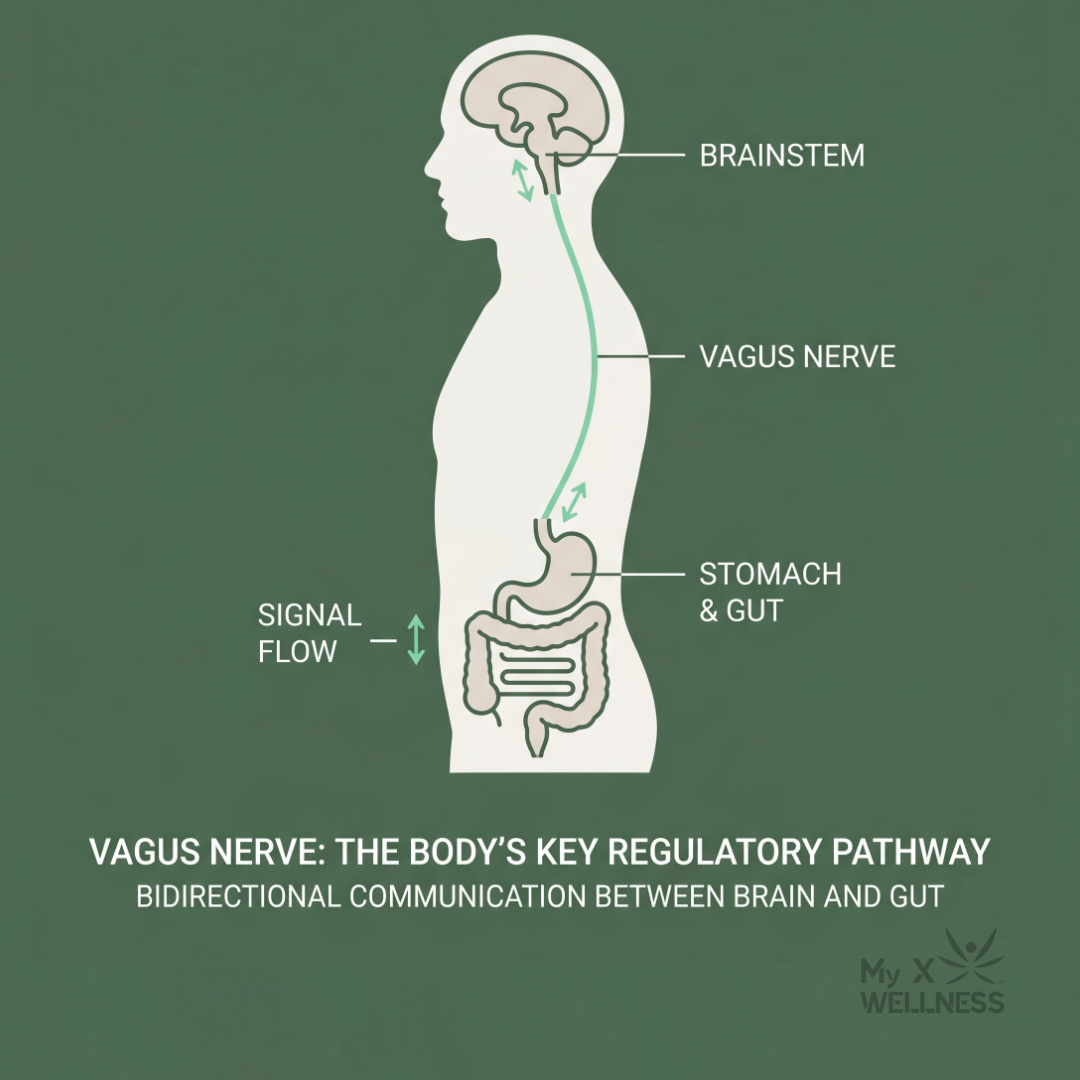
This gut-brain connection isn’t metaphorical. It runs through a physical pathway: the vagus nerve, a highway of nerve fibers that runs directly from your brainstem to your gut, carrying signals in both directions simultaneously.
When your gut is inflamed, dysregulated, or running on a disrupted microbiome, your brain knows. When your brain is under chronic stress, your gut knows. The communication is constant, bidirectional, and faster than most people realize.
Where the ECS Comes In
Here’s what most people — including most doctors — don’t know: your endocannabinoid system is densely present throughout your digestive tract.
CB1 and CB2 receptors — the same receptor types that respond to CBD and CBG — line your GI tract from top to bottom. A landmark review published in Pharmacology & Therapeutics confirmed that the ECS plays a direct regulatory role in gut motility (how food moves through you), gut inflammation, intestinal permeability, and the body’s response to visceral pain.[1]
The ECS is also a primary modulator of the vagus nerve — that gut-brain highway. When the ECS is well-supported, the vagus nerve communicates more effectively. Chronic stress, poor sleep, or an imbalanced microbiome can deplete that tone — and when it drops, the whole system gets noisy.
Here’s the part that genuinely surprised me when I read it: your gut microbiome doesn’t just live in your gut. It actively influences your endocannabinoid system. Research published in Frontiers in Psychiatry found that the crosstalk between gut microbiota and the intestinal ECS plays a significant role in stress-induced changes in the gut-brain axis, affecting both metabolic function and mental health.[2] The microbiome and the ECS are in constant dialogue. Feed one well, and the other benefits. Let one collapse, and the other feels it.
The Anxiety-Sugar-Gut Loop
This is the part I want to talk about honestly, because I’ve lived some version of it.
When anxiety runs high, the body looks for fast relief. Sugar is one of the fastest dopamine triggers available — it’s not a character flaw, it’s biology. The problem is what happens next.
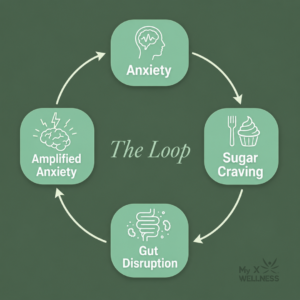
Research published in Frontiers in Nutrition describes this as a documented vicious cycle: anxiety drives emotional eating (typically sugar and processed comfort food), which disrupts the gut microbiome, which increases anxiety signaling back to the brain, which drives more cravings.[3] The gut microbes that thrive on sugar actively send dopamine signals back to the brain that reinforce the craving — they’re essentially asking to be fed.
Why Willpower Isn’t the Answer
What breaks the loop isn’t willpower. It’s regulation.
And that’s where the ECS becomes relevant in a way that goes beyond digestion. Chronic stress depletes endocannabinoid tone. When ECS tone drops, the gut-brain axis loses some of its regulatory capacity — the system that’s supposed to help you shift out of stress response becomes less effective at doing that job. Supporting the ECS isn’t just about gut symptoms. It’s about restoring the regulatory layer that the whole loop depends on.
What the Research Actually Says About CBD, CBG, and the Gut
I want to be careful here, because this is an area where the research is genuinely promising but still developing. Here’s what we actually know.
The ECS is unambiguously present in the gut and plays a documented role in gut regulation. That’s established physiology, not preliminary research.
On cannabinoids and gut health specifically: a 2023 proof-of-concept study presented at the American College of Gastroenterology found that patients with IBS who took a CBD/CBG oral tincture twice daily reported a 33% reduction in abdominal pain scores over two weeks.[4] This was a small, open-label trial — larger controlled studies are needed — but it’s human data using a cannabinoid combination that’s available right now, and it’s the kind of early signal worth paying attention to.
CBG in particular has drawn significant research interest for gut health. A study published in the British Journal of Pharmacology found that CBG reduced gut inflammation and nitric oxide production in a colitis model, with effects modulated through CB2 receptor pathways in the gut lining.[5] CBG also interacts with TRPV1 channels — pain signaling pathways in the gut — and with serotonin receptors that influence motility and nausea.
What Early Studies Show
A 2023 systematic review in Current Developments in Nutrition concluded that CBD shows therapeutic potential for gastrointestinal disorders, particularly around motility regulation and reducing gut inflammation.[6]
None of this is “CBD cures IBS.” But if you’re dealing with gut discomfort, inflammation, or the kind of chronic gut disruption that shows up after years of stress, there’s a legitimate scientific case for supporting the ECS as part of a broader approach.
Supporting your gut ECS:
The research points specifically to CB2 receptor activity in the gut lining. The My X Wellness Extra Strong formula combines CBD and CBG in a 2:1 ratio — with only trace amounts of naturally occurring THC — unflavored and built for consistent daily use. The CBG concentration is directly relevant to the gut pathways covered in this article.
👉 Explore the Extra Strong Tincture
The Gut-Sleep Connection You Probably Haven’t Heard About
This is the bridge I didn’t expect when I started researching this.
Poor gut health disrupts sleep. Disrupted sleep worsens gut health. The relationship is bidirectional and it runs through the ECS and the vagus nerve.
Gut inflammation increases systemic inflammatory markers that interfere with sleep architecture. A disrupted microbiome reduces serotonin production — and serotonin is a precursor to melatonin, which your body needs to initiate and maintain sleep. Chronic gut stress keeps the HPA axis (your stress hormone system) activated, which means elevated cortisol at night, which means fragmented sleep and that familiar 3am wake pattern.
If you’ve been working on sleep and not getting the results you expect, it’s worth asking whether your gut is part of the picture.
Related reading:
What This Means Practically
I’m not going to give you a gut protocol. I’m not a doctor, and gut health is genuinely individual — what works for one person’s microbiome may not work for another’s.
What I will say is this: the ECS is a regulatory system that connects your gut, your brain, your stress response, and your sleep. Supporting it consistently — not as a quick fix, but as a daily practice — gives your body more tools to regulate the whole loop.
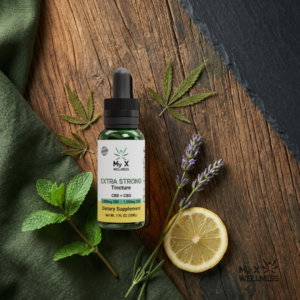
For gut-specific support, I’ve been exploring the daytime use of CBD and CBG — specifically because of CBG’s activity at CB2 receptors in the gut lining. The My X Wellness Extra Strong tincture is what I’d point someone toward who’s dealing with gut inflammation or the stress-craving-gut cycle described above. It’s 100mg CBD and 50mg CBG per dropper in a simple, unflavored formula. While it’s not intended to produce intoxicating effects, it does contain only trace amounts of naturally occurring THC. The CBG concentration is particularly relevant for this application.
👉 Explore the Extra Strong Tincture
If the gut-sleep connection is your entry point — if you’re noticing that gut disruption is showing up in your sleep — the Nighttime formula is worth layering in as a second step. The CBG works on the same gut pathways, with CBN added on top for sleep-specific support.
Subscription saves 20% — and consistency matters more than any single dose.
The Bigger Picture
Your endocannabinoid system is a whole-body regulatory network. It lives in your nervous system, your immune system, your gut lining, and the vagus nerve that connects all of them. When we talk about supporting your ECS — with consistent cannabinoid input, with good food, with stress reduction, with sleep — we’re talking about supporting the system that keeps everything else in balance.
The gut is one of the most important ECS sites in your body. If you haven’t been thinking about it that way, now you have a reason to start.
Related reading:
- 3 Common Mistakes That Are Ruining Your Sleep — and How to Fix Them Naturally
- What Is CBD? Benefits, Uses, and How It Works
References
[1] Izzo AA, Sharkey KA. Cannabinoids and the gut: new developments and emerging concepts. Pharmacology & Therapeutics. 2010;126(1):21–38. https://pubmed.ncbi.nlm.nih.gov/20117132/
[2] Cintoni M et al. The Microbiome and Gut Endocannabinoid System in the Regulation of Stress Responses and Metabolism. Frontiers in Psychiatry. 2022. https://pmc.ncbi.nlm.nih.gov/articles/PMC9130962/
[3] Meroni E et al. Diet quality and anxiety: a critical overview with focus on the gut microbiome. Frontiers in Nutrition. 2024. https://pmc.ncbi.nlm.nih.gov/articles/PMC11133642/
[4] Good L, Baumgartner J. Proof of Concept Open Label Trial of CBD/CBG Oral Tincture in the Management of Symptoms in Adult Patients with Irritable Bowel Syndrome. American Journal of Gastroenterology. 2023;118(10S):S474.
[5] Borrelli F et al. Beneficial effect of the non-psychotropic plant cannabinoid cannabigerol on experimental inflammatory bowel disease. British Journal of Pharmacology. 2013. https://pubmed.ncbi.nlm.nih.gov/23415610/
[6] Story G et al. Cannabidiol and Intestinal Motility: A Systematic Review. Current Developments in Nutrition. 2023;7(10):101972. https://pmc.ncbi.nlm.nih.gov/articles/PMC10541995/
About the Author: Jeff Pearson holds a B.S. in Psychology and M.S. in Communication. He has 30 years of experience in marketing, research, and content strategy across regulated industries including cannabis and wellness. He serves as Affiliate Marketing Manager and Brand Advisor for My X Wellness. A version of this article also appears on FeedMyECS.com, Jeff’s independent ECS education platform.
This article is intended for educational purposes only and does not constitute medical advice.
Very interesting read, I have notice with age my stomach can be very restless while I sleep waking me up constantly, I have been looking for reasons why and what to do about it besides eating through the night which seems to make things worse. After reading how everything coincides with each other and how CBD and CBG helps relieve the gut issues and the late night rumble’s, thanks for the info, please keep em coming